Posts in the Personal Category

Director’s Commentary

Published 18 years, 9 months past

In this latest resurgence of the “are blog comments distilled joy or pure evil?” conversation, I got tagged by Alastair Campbell as someone whose site has good comments.  This would be a great time for an abashedly mumbled “aw, shucks, it ’tweren’t nuthin'”, except saying so would be a complete lie.

Want to know how I get good comments?  I work for them.  Part of that is striving to write good posts that will get good comments.  Another part is leading by example.  And a third part is a willingness to filter the comments I get, and saying as much up front.

The first part is in many ways the hardest, because what I think is a good post may be judged otherwise by my readers.  I could spend days and days and days on a post that merits a collective “meh”.  From that, I learn.  If this were solely a “me shouting whatever comes to mind” site, then I wouldn’t care so much, but this is a conversation site.  The goal here is not for me to pronounce my views from on high and thus change the world.  The goal here is to share information, with the sharing going in both directions, and thus change ourselves.

The second part is a lot easier for me, but seems to be harder for some.  It’s very, very rare that I will post confrontationally or abusively.  The few times I’ve done so, I’ve gotten some strong pushback, and no wonder.  The vast majority of the time, the posts conform to the site’s overall Airbag Blog Advisory System warning level of Guarded (“Someone might disagree with you, but only after apologizing for it first”).  Unsurprisingly, the non-spam comments that come in are respectful, helpful, and civil about 99% of the time.  Whether the tone of the site only draws people who are naturally that way or it shepherds all kinds of people in that direction is unknown, and to me wholly irrelevant.

It’s also the case that when the comments and the post match in tone, it’s much more likely that subsequent comments will keep to the same tone; that is, that the commenters help me in setting the tone for the site.  And I always, always appreciate that they do so.  (So thank you!)

The third part can be taken one of three ways.  You can say that I’m like a curator who lovingly tends a growing collection of thoughts and contributions, only excising those that would damage the overall whole; or that I’m a tiny fascist who only lets through comments that meet my personal standards of acceptability.  The thing is, both are true (which is the third way you can take it).

Y’see, this here blog is to me an extension of my home.  In my house, some things are acceptable and others are not.  Nobody is allowed to smoke in my house, for example.  In terms of speech, I’m pretty tolerant of what others have to say, but there are lines and I will enforce them.  Have enforced them, in fact, usually gently—although I once very nearly ejected an out-of-town friend who was staying with us from my house for something that was said.  And no, I won’t tell you who or why.

So as I say, you can take that as abrogation of my visitors’ freedom of speech and an exercise of my right to make my home the kind of place I want it to be.  It really is both.  I don’t see that as a problem.

I treat css-discuss the same way, actually.  It is, and always has been, a benevolent dictatorship, with policies that are enforced.  When people go off-topic, the moderators say so and end the threads.  When people get abusive, they’re warned to stop it, and can and will be ejected from the list.  In fact, I’ve done so twice in the list’s five-year history.  The moderators and I work actively to shape the list, and it has paid off.  The community now mostly polices itself, and the need for moderator intervention is becoming more rare.  Over time, it’s become a very helpful community with a very high signal-to-noise ratio.  Others have observed that it’s spawned one of the few truly useful group-run wikis in the world.  None of that just magically happened.  It required years of effort by me, and then by the moderation team.

(And before someone says that a small mailing list is different than a globally available blog, remember that css-d has over 8,300 subscribers from all over the world.)

The other person who got mentioned in Alastair’s post as having a good-comment home was Roger Johansson, who recently contributed his own thoughts on the topic.  In that post, he hits a lot of the pros and cons of allowing comments: the feedback, the spam, the community, the abuse.  One of the most subtle effects of comments is that it does make you think harder about what you post:

I realized that as I was writing I had started to subconsciously think about what kind of comments a post would trigger. I found it harder and harder to write freely, and to express myself the way I really want to.

It’s the same for me.  The few times I’ve posted things I knew were going to contentious, it was after a lot of thought and consideration.  In fact, almost everything I post goes through some degree of pre-approval based on what kinds of comments I think it will trigger.

Where I would seem to part ways with Roger is that I don’t think that’s a bad thing.  One of the things those opposed to blog comments cite is John Gabriel’s Greater Internet F—wad Theory (warning: contains strong language)—as if it only applied to commenters.  The basic anonymity of the Internet isn’t a case of not knowing names: it springs from the very, very low chance that we’ll ever meet in person.  It applies just as much to those who write blog posts as those who comment on said posts.

Still, that sounds like I’m allowing the community to impose some constraints on me.  Actually, it doesn’t sound like that: it is that.  But I choose to do that, and frankly, I don’t think anything is lost in the bargain.  Quite the contrary.  I think more than a little is gained.

So weirdly enough, I find myself in disagreement with Joel Spolsky when he says:

The important thing to notice here is that Dave [Winer] does not see blog comments as productive to the free exchange of ideas. They are a part of the problem, not the solution. You don’t have a right to post your thoughts at the bottom of someone else’s thoughts. That’s not freedom of expression, that’s an infringement on their freedom of expression.

It’s the last sentence where I disagree, not the rest of it, which is provided for context.  That last sentence is like saying that when I have an in-person conversation, anything the other person says is an infringement on my freedom of speech.  In fact, it’s like saying that my response to his post infringes on his freedom of speech.  Which is just silly.

Neither is my pre-filtering of posts an infringement of my speech.  I am not forced to allow comments, nor to pre-judge my posts based on the expected reaction.  It is something I voluntarily accept as part of having an extended conversation.  If I felt that was becoming too much of a burden, I’d turn off comments.

I don’t have comments here out of obligation to some imagined right.  I have them because they’re invitation to contribute, to enrich, to converse.  Just look at what happened with the reset styles: over the course of a few posts, my original work was built upon and improved.  The same thing happened in the early days of S5.  Without comments, neither of those efforts would have gone as far nor been as well-developed as they eventually were.  No, not even with e-mail, which is one-to-one and so doesn’t allow for the commenters to converse with each other.

Of course, not everyone wants to have a conversation right on their site, which is fine as well.  I don’t think Daring Fireball is lessened for its not having comments.  But part of the reason I think that is that John, being a strongly opinionated sort, would probably get the same kinds of comments in return; the bread you cast upon the waters will be returned to you tenfold.  And the fact that much of his posting is about Mac and Windows wouldn’t help much, either.  Nothing invites comment incoherency faster than having a blog about a contentious issue.  (See also: political blogs.)

As well, there’s nothing that says one must have comments always on, or always off.  It’s generally the case that I don’t open comments on the most personal of my posts, particularly those about Carolyn.  In those cases, I close comments because I’m writing them for me and to share those moments with the world, and don’t want positive or negative feedback.  They’re not meant to be conversations, in my view.  They’re snapshots.

(I’ll admit that I may be influenced by the fact that it was a Carolyn-related post that earned me one of the most vitriolic personal attacks that I’ve allowed to stand.)

It is absolutely the case that having good comments is hard work.  It requires leading by example and a willingness to curate/censor the comments that do come in.  And I absolutely think that anyone unwilling or unable to do that work should disable comments.  Because when a site’s comments devolve into “Useless noise[;] Thoughtless drivel written by some anonymous non-entity“, that’s as much the responsibility of the site’s author as of the commenters themselves.

Thus, for meyerweb, I hold to the inverse of Jeremy’s corollary of Sturgeon’s law: here, comments should be enabled 90% of the time.  I would not think to apply either rule to the world at large, of course.  For many sites, comments probably should be off by default.  But not for mine.
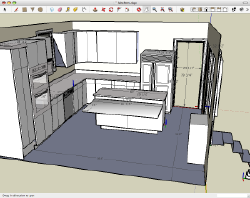

Another Soul Lost to SketchUp

Published 18 years, 9 months past

Hitting a link shared by Unstoppabot, who really needs to get around to fixing his feed linking policy (“View this site”?  Lame!), I was seized with another spasm of appreciation for the deliciousness that is SketchUp.

I did a moderate amount of 3D modeling back in the day.  The specific day in question would be the one where we all thought that images of rendered 3D models and, whenever possible, blobs of text were the absolute last word in Great Web Design.  Remember that?  Wasn’t it fantastic?  When every page title could be a bunch of extruded and beveled sans-serif letters viewed slightly from above, with the whole mess of text angled away from the observer?

Good times.

So anyway, while I was cranking out renderings of page title text and university logos, I also spent some time creating scenes of other stuff.  You can find some of the results if you dig deeply enough here on meyerweb, but that’s not my point.  What I’m trying to say is that I enjoy a bit o’ three dee more than most, and have some knowledge of how difficult it can be to construct models.

When I first heard about SketchUp, I was intrigued but didn’t really buy into all the hype.  It couldn’t be that easy, could it?  And then I watched someone using it—at An Event Apart, as it happens; and no, it wasn’t one of the attendees—and was captivated.  I downloaded the installer while I was sitting there, watching him create and modify shapes as easily as sketching them on paper.  And then I left it uninstalled, because I was afraid of what it would do to my free time.

A few days ago, I finally broke down.  I actually did have a legitimate reason to install and use it, a really good one, but of course I’d been waiting for any reasonable pretense to launch the .dmg and make with the modeling.  So I did.

Color me deeply impressed.  While you’re at it, add some heavy tints of addicted.  I started by modeling our kitchen, and now I want to do the whole frickin’ house.  I’m starting to eye local landmarks for recreation and contribution to the Warehouse and Google Earth.

I don’t have time for this.  I need help.  Stop me before I model again!


Odd Seating Arrangments

Published 18 years, 9 months past

This evening, we decided to cap off the weekend with dinner out.  Carolyn was in the mood for french fries, and the rest of us were looking for decent dinner fare, so we decided to hit Brennan’s Colony.  This is one of the more fascinating restaurants on our side of town.  From both the outside and the inside, it looks like a low- to middle-rent bar, all uncushioned wood benches and odd angles and dimmish lighting.  The baseline menu is burgers and fried food at very affordable prices.

And then you get the dinner menu, and you wonder from which other restaurant they swiped their menu.  Chicken breast stuffed with goat cheese in a bearnaise reduction, or words to that effect.  Mint-crusted New Zealand rack of lamb.  Et cetera.  It is, to use a word I picked up on my last trip to Ye Jolly Olde Englande, a gastropub, only with really good food.

We hadn’t gone for a while because, being a bar, smoking was permitted, and while they had an area labeled “No Smoking” it was about as effective as setting up a ring of buoys just offshore and marking that area “No Water”.  We used to go every now and again in olden days, but after Carolyn’s arrival, it was stricken from our dining list for the obvious health reasons.  However, Ohio voters passed an indoor smoking ban late last year, so we could once again eat and breathe.  Everybody woohoo!

Only when we arrived and asked for a table on their newly opened outdoor patio, we were told Carolyn wasn’t old enough to be seated there.  We could eat indoors, but the patio was off-limits to anyone under the age of eighteen.  This baffled us just a little all by itself, and then we turned around to behold a pre-teen boy sitting at the bar, eating a sandwich and drinking a Coke.  At least we hoped it was a Coke.

We brought this oddity (and, if I’m not mistaken, violation of Ohio state law) to the staff’s attention, and were told that he was seated there because they were so busy.  But no kids on the patio!  No no!  That would be, um, whatever they feared would come of allowing children to eat at an outdoor table.  The apocalypse, no doubt.

So we ate at The Tavern Company a little way down the street, where they were more than happy to have us sit wherever we liked, indoors or out—the presence of a smallish, well-behaved child notwithstanding.

I think we’ll keep to that seating arrangement for as long as the policy at Brennan’s remains.


Torna A Surriento

Published 18 years, 9 months past

Ma nun me lassà, Nun darme stu turmiento!

Luciano Pavarotti died last night of pancreatic cancer at the age of 71.

Among my “classical” recordings, the original Three Tenors concert holds a special place, one that has survived nearly every iPod reorganization I’ve undergone.  What I find most fascinating about that recording is the marked contrast between the three stars, and just how much Pavarotti stands out.  I’ve thought about the reasons why that is, and I think it comes down to his restraint in the use of vibrato.  Whenever I hear a singer whose long notes are more warble than tone, I wince.  I recognize the physical skill that goes into producing the sound, but the result is actually uncomfortable to me.  This is why there’s hardly a soprano I can stand; they all seem to exist solely to find long notes to strangle.

Pavarotti, in contrast, used vibrato as a shading on his notes.  At their core, they were long and pure and steady.  Yes, at times he went for all-out vibrato, but it always seemed to make sense when he did.  He wasn’t warbling to show that he could do it; he did it when and how it was right.  That, coupled with the sheer power of his voice, creates an emotional punch that I’m powerless to comprehend but joyful to behold.

I listened to some Pavarotti this morning, and though his heartbreaking renditions of “Nessun Dorma” and “Torna A Surriento” have always misted me up a little, this time there was an extra tightness in my throat.

Part of me hopes that nobody is asked to sing at his memorial services; or, if anyone is, that they turn down the invitation.  Nobody could do the job as well as he would have.

E noi dovrem, ahimè, morir, morir!


Staging The World Over

Published 18 years, 9 months past

Despite my best efforts to cut back on travel, the 2007 world tour seems to be continuing apace.  In addition to my sessions at An Event Apart in San Francisco at the beginning of October, I’m due to hit (at least) three four other stages before the year is out.  Here’s the skinny:

  • I’ll be doing a short bit on microformats at the Cleveland Web Standards Meetup.  If you’re in the area and interested, please do sign up for the group!  We’ve been growing quickly and, having shifted our meeting place to the Tri-C West campus, now have room for a lot more growth.  We’re also moving beyond simple gathering, with some great ideas for helping out local organizations and sharing knowledge and skills.  Even if you can’t make this month’s gathering, you should still join up so you’re in the loop.

  • I’ll be delivering the keynote at the first annual CIW Partner Conference in Destin, Florida, at the end of September.  No official title for the talk as yet, but the general theme will be how we’ve gotten to where we are, what I see as the best ways to train the next generation of web designers and developers, and the best tools currently available to current designers/developers.  I may also participate in a panel, depending on exact scheduling.

  • In mid-October, I’ll be on stage at the first Voices That Matter: Web Design conference in San Francisco (which will make my second trip to the city in the space of three weeks).  We’re looking to do sort of an open “Conversation With…” format with lots of audience questions and commentary, which is a little unusual for me.  Jeffrey and I did a conversational session with Brian Alvey at ‘Meet the Makers’ back in the day, but I haven’t really done a Merv Griffin since.  Should be fun!

  • Then, in mid-December, I’ll be doing three hours of CSS at Web Design World Boston.  It will pretty much be like it was last year: a mix of deep dives into obscure (yet important) corners of CSS, assessments of current trends, fun with cutting-edge techniques, and open-format Q&A.  We’ll have three hours (with breaks) to play around, so that’ll leave plenty of time to wander into the weeds and come back mostly intact.

I’m starting to do some rework on the sidebar here on meyerweb, and a “coming soon” list is one of the things I have in mind.  Those of you who actually do drop by the site will probably notice the sidebar mutating over time, since I’m going to do my reworking live and in public.  That sounds so much more grandiose than the reality of fiddling with markup and making mistakes, doesn’t it?  It’s editing 2.0!


Contrived Conflicts

Published 18 years, 10 months past

CSS Sculptor got a very nice write-up from King Z over at The Daily Report, for which I thank him profusely.  I think he’s pegged the tool pretty well in terms of its intent and target audience(s).

What mystified me was the turn the comments took: suddenly they went from giggling over the splashimation and exhortations to port Sculptor to other environments (Coda got several mentions) to an multi-party argument over which was better, Sculptor or Project VII‘s CSS Layout Magic.

Um, why?

As Al Sparber, creator of Magic, stated quite accurately, “They are two very different tools conceived in very different ways”—nothing to add to that, really.  But even if we were to imagine a world where they were very similar tools that operated in very similar ways, I still don’t see why it would have to be a “battle” situation.  It’s not like our world is so small that there’s only room for one of any given thing.

I mean, take a step back and look at the wider development landscape.  There are a whole bunch of web development environments out there (Dreamweaver, Expression, Coda, Firefox with extensions, etc.).  All of them serve the community, each in its own way.  Each is used by a community of people, many of whom gather to help each other improve their skills.  Why try to create conflict between those communities?  What useful purpose could that possibly serve?  We’d be as well served to start a Mac vs. Windows vs. Linux debate.  Which is to say, not at all.

And so it is with the artificial conflict that so mystifies me, that of Sculptor vs. Magic.  Project VII has very loyal customers, and rightly so: they put out great stuff.  I hope that we’ll also have loyal customers, because that will mean we also created something great.  (Obviously, I already think we did, but then I would, wouldn’t I?)  It seems kind of obvious to me that these two communities have way more in common than they do differences.  My usual reaction on encountering someone who’s a huge fan of a web site or a piece of software is to smile and nod knowingly, like we’re part of a secret club or something.  Because in a sense, we are.  We get fired up by the same kinds of things.  We’re our kind of people.

I admit this is veering dangerously close to plaintive “can’t we all just get along?” territory, but c’mon, folks.  There’s already more than enough tension and conflict in the world.  Let’s try not to add to it, yeah?  Now everybody throw the hörns!  Seriously, throw ’em, and put in a little “ROCK!” just for me.  You’ll be amazed at how much better you feel.


CSS Sculptor Released

Published 18 years, 10 months past

I alluded yesterday to “backstage work”.  One of the things going on back there was my work with the folks at WebAssist to create a tool that allows both novice and experienced web developers to create and alter CSS-driven layouts.

The end result is Eric Meyer’s CSS Sculptor (v1.0.0), a Dreamweaver extension that gives the user tons of options and outputs pretty darned clean markup and CSS.  (Even if you’ve no interest at all in Dreamweaver tools, you should still follow that link.  How many chances are you going to have to see me throw the mëtäl hörns?)

Well you might wonder how much code I contributed to this software.  Well, okay, none.  What I did contribute was guidance on the interface and its organization; on what options to present, and how; on ways to handle things like print styles and the print CSS options; and on the CSS and markup that results, including the optional explanatory comments in the CSS.

One of the primary goals with this project was to create a tool that would expose as much CSS as possible to users without overwhelming them, and that would actually teach by dint of showing all the options.  One of the things we heard a lot in the beta test was users saying things like, “Oh, so that’s what that CSS thingy does! I’d always wondered.”  Which was exactly what we’d hoped to hear, along with “Hey, I’ve never heard of this CSS property before!”.  (We heard that one too.)

There are some things I expect will be improved in future releases, like shorthand value minimization—the simplest example of that being a condensation of 0 0 0 0 down to just plain 0.  We discussed including that feature but decided to postpone it for a variety of reasons, not least of which was working out the logic required to figure out when to minimize, which isn’t as simple a problem as you might first think.  There were a few other things we didn’t get in the initial release; such is the way of software.  We’ve got a list of potential features, of course, and are looking forward to hearing what users suggest.

As for what features did make it in, there’s a fairly large list, so it’s probably best to check out the Features page or take the product tour—with video commentary starring, you guessed it, yours truly.  So if you’ve ever wanted to see me greenscreened over screenshots and being intermittently goofy, then at long last your prayers have been answered!  (Or will be, once we get the load problems resolved.)

What makes this whole thing an especially interesting experience for me is that, for the first time in my life, I’m participating in an affiliate program.  Basically, what I earn from sales of CSS Sculptor depends on affiliate fees earned by referral links like this one here (and also earlier in the post).  That might sound like a rip-off, but it has the potential to be quite the opposite.  The affiliate cut is literally an order of magnitude greater than any reasonable per-unit royalty would be.

This compensation scheme (as they say in the UK) is actually an experiment on both sides: WebAssist has never really worked with an outside individual on a product like this, and so they honestly don’t know if the affiliate approach will pay better than a per-unit royalty, or worse.  So we’re going to try it out and see what happens.  Fortunately, I’m in a position that I feel I can afford to experiment like this, allowing both myself and WebAssist to find out what works best in the long run.

Thus, if you’re planning to buy CSS Sculptor or know someone who is, I’d be grateful if you either clicked through one of the links hereabouts or linked to the product using my affiliate URL.  I’ll have a link in the sidebar in the near future as well.  The sidebar’s due for an overhaul anyhow.

So that’s one of the things that’s claimed my time over the last few months, and I’m pretty excited that it’s seeing the light of release.  I’m even more excited about finding out what people think could be better about it so that we can improve what’s already a pretty darned nifty tool.  If I do say so myself.


San Francisco Schedule

Published 18 years, 10 months past

Amongst all the travel, there’s been a metric ton of backstage work going on.  This is generally true of me these days, which is why posting has fallen off in 2007.  Unfortunately, it’s meant that I’ve been lax about keeping you folks up to date on what I’m up to—and also to keep you informed about An Event Apart, which is what accounts for most of that backstage work.

For example: last week, we announced publication of the complete schedule for AEA San Francisco, which will be 4-5 October 2007, and I didn’t say a word here.  I should have; honestly, it’s amazing.  I already want to see it.

I know, I say that every time, but it’s always true.  One of the things that makes me proudest about AEA, and that makes me continue to work hard on AEA, is that it fulfills one of the core requirements Jeffrey and I set out: to create the kind of event we’d want to attend.  I’m not satisfied with an AEA show unless I can look at it—and I mean all of it, from the schedule to all the organizational details that aren’t always obvious—and say, “I would pay money out of my own pocket to see this show”.

And so far, I’ve always been satisfied.

So we end the 2007 series with another great lineup and incredible set of talks in San Francisco, and it makes me proud all over again.  I hope you can be there to see it.


Browse the Archive

Earlier Entries

Later Entries