Posts in the Tech Category

Inaccessible Accessiblity Information

Published 23 years, 5 months past

Remember the flap, back in April, when the Section 508 site‘s markup didn’t validate?  Guess what: it still doesn’t, but that’s not what I’m here to talk about.  I just found, thanks to a co-worker, a story almost as good.  It involves Microsoft’s Accessibility page.  Think it’s accessible, let alone legible in anything other than Explorer?  Hah!

Given my employer, I thought about taking a pass, but you know what?  To heck with it.  I’d be taking Microsoft to task over this if I worked for myself, so I’m going to do it now.  So here’s the deal: go to the page using a Gecko-based browser like Mozilla.  Or use Opera, which has its own display problems, but which aren’t the ones I’m about to describe. A screenshot showing poorly styled links on Microsoft's Accessibility page. Okay, take a look at the links on the right side of the page.  Nice.  Even someone with my eyesight can’t read that text without major squinting.  I suppose there’s a witty remark to be made about forcing the user to squint at a link to a page on “Visual Impairments,” but in a rare display of moderate taste, I’m not going to make it.  Now look at the left rail.  A few of the links, and all of the search area, are completely gone (you may have to compare the page in Explorer to see what I mean).  They’ve been pushed out of the top of the left rail.
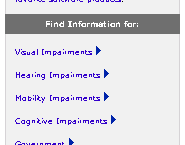
Are these display errors due to bugs in Gecko?  No.  They’re due to sloppy authoring practices made possible by bugs in Explorer.  To wit:

  • The teensy link text is due to the site’s use of font-size: x-small for the table that encloses the links.  IE thinks x-small is one “step” below the user’s default font, when in fact it’s two “steps.”  To give some rough approximations, IE thinks it’s 80% normal whereas it should be 60% normal.  (Those percentages are close to reality, but remember that CSS doesn’t define how big or small the keywords should be.)  Changing the value to small gets you a decent display in Gecko, but of course the text gets bigger in IE, which thinks that small is the same size as the user’s text.  As opposed to, say, medium, which is clearly defined to be the same size as unstyled text.  Todd Fahrner has written about this topic far better than I ever could; see “Toward a standard font size interval system” and “Size Matters” for details and good advice.
  • The cut-off links and search area are due to stupid table tricks.  The entire left rail is a single table cell with a bunch of stuff inside it—no great surprise there.  But how does Microsoft try to get the content of the rail up against the top of the cell?  By sticking in a table with a height of 100% below the rest of the cell’s contents.  IE assumes that if an element is too tall, then it should be resized.  Gecko, on the other hand, properly calculates the height of this table to be equal to the height of the entire left rail.  So you have a table as tall as the whole rail, and then more content above it, and all of it is vertically centered in the rail… which means the visible content gets pushed out of the cell.  The fix?  What most any Web designer would have done in the first place: add valign="top" to the rail’s cell.

In addition, the page’s markup comes nowhere close to validating (of course!) and is composed of so many convoluted, nested tables, spacer GIFs, and font tags that I shudder to contemplate what a screen reader, or a text-mode browser, might end up displaying.

It’s not like these particular authoring errors were difficult to spot, or even to fix.  Tracking down the source of the problems and fixing them took me about 20 minutes, tops.  I think I’ve spent more time writing and editing this rant than I did on the diagnosis and testing of the fixes described above.  Of course, there are doubtless other problems on the page, but if so they weren’t immediately obvious—and as much as I’d love to spend my days fixing obvious authoring mistakes for other people, I only have 50 or 60 more years to live.  I hate to start a project when I know I can’t finish it.

What is it about accessibility sites that brings out the absolute worst in the Web and its authors?


Let It Go, People

Published 23 years, 5 months past

I hope everyone enjoyed the “Eric Meyer made up Jeffrey Zeldman” thing.  I’m still sort of amazed by it all, and Kat and I have gotten more than a few chuckles out of it.  I freely admit that I don’t have the creativity to come up with Jeff—he’s far too unique and interesting a guy to be my invention.

So Netscape 4.8 was released.  The howls of protest began immediately; I noticed disparaging comments from Zeldman (who was pretty funny about it, of course), Shirley, and Meryl, among others who I can’t recall at the moment, not to mention a mercifully short thread on css-discuss.  Apparently this release is the worst thing to happen to the Web in memory, or something like that.

To which I say: could we all please calm the %#@$#! down?  As I’ve tried to explain several times, updates to Netscape 4.x are driven by security patches.  Period.  End of story.  The rendering engine does not change, so it’s not like there are new bugs to worry about there.  These updates are required by support contracts between Netscape and enterprise users.  I suppose Netscape could just abandon the product line and leave enterprise customers open to future security exploits, rather like some other companies that spring to mind.  Yeah, that sounds like a swell idea.

To get back to my original point: the louder people howl about new a NN4.x release, the higher its visibility, and so the more people will actually download it.  See where I’m going with this one?  If people would just ignore the NN4.x releases, there would be fewer NN4.x installs in the world.  Users would instead find another, more current browser.  Everybody wins.  How hard is that?

Sometimes I’m astonished by the human drive to stir up controversy where none need exist, not to mention the ever greater drive to complain at length about trivial things.  Sort of like I’m doing right now, in fact…


css-discuss Public Archive Announced

Published 23 years, 5 months past

The very active mailing list I chaperone, css-discuss, has always had an archive.  However, it was only open to list members so that spammers couldn’t harvest the members’ e-mail addresses, it wasn’t searchable even for members, and it had some stupid display problems that were beyond our control.  I always felt a little embarrassed about sending list members to the archives, but it was all we had.

Well, good news, CSS fans.  List member Simon Willison has put together a very slick public archive of the list where e-mail addresses aren’t exposed, and the incredible depth and breadth of content the list represents is now available to non-members and Google alike.  The archive is even searchable using Boolean terms, so you could run a query to get every post Mark Newhouse has ever made to the list where he mentions floated elements.  For example.

This is an amazing resource, the collected discussion and experience of 2100+ list members now available to the world.  Simon (and his company, Incutio, which is generously hosting said resource and developed the archiving software that drives it) deserve hugs, hosannas, and high praise to the heavens for putting in the effort to make this a reality.  Spread the word.

Speaking of words to be spread, here’s another: DevEdge just got a makeover and a new address.  The legacy site will live where it always did, at developer.netscape.com.  The address devedge.netscape.com will point to the new site, which was laid out and styled by yours truly.  The new site is where we’ve concentrated all of our cross-browser information and work, including scripts and tools you can use today.  Check it out!


Wednesday, 12 June 2002

Published 23 years, 7 months past

Digital Web has published an interview with yours truly, conducted by Meryl K. Evans.  I get to babble on for a bit about CSS, the W3C, Netscape, and my radio show.  Now, if only I could figure out what they did with the picture I sent them… I just hope I don’t get Photoshopped onto Salacious Crumb’s body, or something.  (Update: I found out what they did with the picture.  Whew!)

Scott Andrew LePera’s brilliant Netscape 4 birthday gallery has a new home on his site.  If you haven’t seen it already, go forth and partake of its artistically acid bounty.


Tuesday, 11 June 2002

Published 23 years, 7 months past

Today, on the fifth anniversary of Navigator 4.x’s release, the Web Standards Project rebirthed itself.  Check it out—the sprightly new site is remarkably free of birthing fluid!  And even this soon out of the womb, the WaSP has some things to say to you, not all of them soothing.

Speaking of NN4.x turning five, Scott Andrew has some things to say about that.  Go now, before the day is over.  In addition to some lovely digital artwork, it’s haikuriffic!


Monday, 10 June 2002

Published 23 years, 7 months past

The last paragraph of Wired’s article “Browsing Around for New Targets” caught my attention:

But one HTML contractor, who asked not to be named, illustrated the uphill battle the WaSP faces in getting programmers to lay aside their old browser-specific tricks: “Do you know how much I get paid for knowing this stuff?”

Yep.  And can you imagine how much more you’d be paid if you knew how to code to standards, thus delivering a superior product with outstanding delivery capabilities?  Not to mention what kind of reputation you’d build up for doing so, and how much more you could charge then?

Actually, it occurs to me that something the WaSP ought to do (if they haven’t already; we’ll find out tomorrow) is create an executive-level whitepaper that basically says, “If you’re still shelling out for multiple versions of a site and 80KB HTML source, you’re paying way too much for way too little.  Stop paying people to know how browsers worked two years ago, and start paying for people who know how to make your site work two years from now.”


Wednesday, 24 April 2002

Published 23 years, 9 months past

Apparently my recent posts have lead some people to think that it’s time to resurrect my former title of Mr. Bitter, so the following two items come just in time.

  • How weird is the world?  Try Mr. Elmo goes to Washington.  This is one of those news items that proves to me that I didn’t really miss anything by passing on recreational chemical use.  Is it a sign of the End Times that we have unkempt sock puppets testifying before Congress?  (Besides Rep. James A. Traficant, I mean.)  Speaking of the Apocalypse…
  • How weird are people?  Try publishing an article claiming that PURE EVIL lurks in every Apple Macintosh.  (Scroll down a bit to get to the largest section, titled “Apple Macintosh.”)  I haven’t laughed this hard in weeks.  What makes it even better is this: read through the whole article, taking special note of the points about how the core of Apple’s new OS is a type of Unix and thus runs “daemons” in the background and contains the “secret code” chmod 666.  So obviously Unix is a tool of Satan, and no God-fearing Christian could possibly consider associating themselves or their data with any such operating system.  Got all that?  Now go to the root level of the server, and check out the OS information at the bottom of the page.  Now that’s funny!

So don’t worry: the world is too amusingly surreal for me to stay permanently bitter.  I get outraged sometimes, but that’s because I want the world I inhabit to improve, not deteriorate—and I want it now more than ever.


Wednesday, 10 April 2002

Published 23 years, 9 months past

Revenge of The 508 Follies: So the U.S. government’s Section 508 Web site has removed its “best viewed with” line that caused me such angst last week, which I suppose is a positive step.  Unfortunately, they have yet to fix either their HTML or CSS to be valid.  I’d rather they had fixed the code and left the annoying text… but I suppose I should be grateful that some improvement has occurred.


Browse the Archive

Earlier Entries

Later Entries