Thoughts From Eric Archive

Reading the Signs

Published 20 years, 7 months past

Back in January, I wrote about teaching Carolyn sign language, and enough time has passed and things changed that it seems like a good time to revisit the topic.  (Also, our friend Gini wrote about it, and that spurred me into typing.)

As I mentioned back in January, we started out with Baby Signs but moved on to American Sign Language (ASL).  This has held true, and when the next child comes into our lives, we’ll use only ASL signs.  To me, the real value of Baby Signs is in showing you where to start: with needs like food, water, milk, and so on.  In moving to ASL, we’ve been immensely helped by the Signing Time video series, which Carolyn loves.  She watches one every other day or so, which is about as much TV as we let her watch, and she can identify each one with a different sign.

At the time I last wrote about it, Carolyn was using about thirty signs.  She’s now somewhere past two hundred signs—I don’t know the exact number, as Kat and I lost track a while ago.  This includes all the primary colors, emotional states, and much more.  She’s also started to speak, with about twenty or so verbal words.  It gets really fascinating when she combines them.

For example, she’s started asking me if I’m done working whenever I come downstairs from my office.  She does this by saying “Daddy?” while signing “work” and then “done”.  If I confirm that I’m done working for the day (or at least for the moment), she’ll do it all over again, except this time saying “Daddy” in a satisfied tone of voice instead of as a question.  Then we spend some time playing.

In fact, one of these exchanges led to Carolyn telling me what she wanted to do when she grows up.  After confirming that Daddy was done working for the day, she thought a minute, then signed “work” and emphatically pointed to herself.

You want to work?” I asked, a little bit surprised.  She nodded and said “yeah!” (one of her favorite spoken words).

“Okay”, said I, amused, “what do you want to do when you work?”

She thought a moment more and then signed “airplane”.  My mouth dropped open.

“You want to be a pilot?” I asked.

She said “yeah!” again, quite enthusiastically, and then ran off to kick a ball across the yard.

Now, it’s possible that Carolyn was saying that she wants to do whatever Daddy does, because when he leaves for a few days, he’s left on a plane.  But my gut feeling was that she was saying she wanted to work on or with airplanes.  Attendant, sure; engineer, why not?; but pilot was the first thing that came to mind.

Then again, about a week later, she told us she wanted to work on swings and slides.  So I guess she’s still evaluating her options.

She also can identify different bedtime stories through signs and speech.  “The Bear’s Water Picnic” is represented by the sign for “water”; “Goodnight Moon” by the sign for “moon”; “Pete the Sheep” by the spoken word “baa”; and so on.  Although she usually picks the same set of stories each night, she can clearly tell us when she wants something different.

For months now, Carolyn’s been able to distinguish between being hurt and being scared when she falls down.  As we hold her, we just ask her if the fall hurt or scared her, and she tells us.  That alone would have made the whole effort worthwhile, because she has told us what the problem is, and so we know how best to comfort her.  It also seems to calm her down simply to tell us, the same way it can make an adult feel better just to say out loud what is upsetting them.

She can also tell us when we’re being silly, when she’s surprised, and more.  When a baby near her cries, she always looks concerned.  We can tell her that the baby is sad, or grumpy, or hungry, and she can sign back the emotion to indicate she understands.

So has signing delayed her speech?  There’s no way to know.  Her speaking vocabulary is on track, according to our pediatrician: some kids do speak early, but to have three spoken words at 18 months is normal, and she was at five.  Plus over 100 signs, which has caused our pediatrician to consider her bilingual.  According to the father of a deaf child with whom I recently conversed, most independent studies show that signing has no major impact, positive or negative, on speech development, at least across the whole study group.

Regardless of whether or not the signing has slowed or sped Carolyn’s development of speech, it has quite definitely accelerated her ability to communicate.  That, to me, was the whole reason to use signs.  For a year now, she’s been able to communicate her needs and wants, and for at least half a year she’s been able to converse with us in some fairly complex ways.

Perhaps as a result of this, Carolyn is entirely capable of following multistep directions, like: “Please go pick up the stuffed cow and put it where it belongs, then come back to Mommy”.  If she’s nervous about a person or situation, we can find out what’s bothering her and show her that it’s okay; conversely, we can tell her when something is dangerous when it might not appear to be, like a hot plate, and get confirmation that she understands.  We’ve been able to teach her to sign “please”, “thank you”, and “excuse me”, and she understands when each is appropriate, sometimes saying them without prompting.  We can get her to calm down for a not-desired nap by asking what she wants to do instead of napping, and then telling her she can do it later, after she takes the nap.  In other words, she’ll agree to delay gratification, so long as we assure her that she’ll get what she wants after doing something that we want her to do.

Remember that she’s not yet two years old.

While Kat and I sometimes augment our words with signs, most of the time we just talk to Carolyn, and she responds with whatever combination of words and signs is needed.  So she has all kinds of exposure to speech, and her development in that regard seems fairly normal.  It could be that she’d have spoken earlier without the signs, but then again it could be that she’d have spoken later.  Maybe the signs have reduced the incentive to speak because she can get by without speech, or maybe the signs have shown her how powerful communication is and thus increased the incentive to speak.

We have no way to know, now or ever.  All that I know is that she has been communicating with us for many, many months more than she would have otherwise, and that she’s almost certainly a much happier and better-adjusted child as a result.

Back in May, I said that “…if you’re a new parent or a parent-to-be, I strongly recommend that you try this with your own baby”.  Take that sentiment and increase it by an order of magnitude.  I truly believe it’s one of the best parenting decisions we ever made.


Big Screen, Small Screen

Published 20 years, 7 months past

The gadgets in my life have recently reached a new level of extreme disparity.

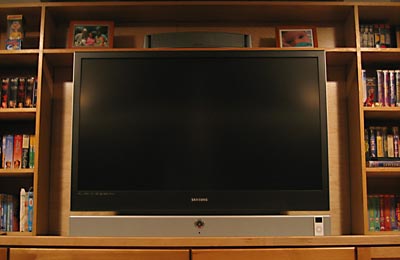
At the enormous end of the scale, there’s the new television we put into our newly-finished basement.  It’s a 50″ widescreen high-definition DLP set, and even though it integrates fairly nicely with the shelving and cabinetry we had built, it still looks stupidly big to me.  When watching a movie, it really gives you a movie-theater experience, simply by taking up so much of your field of view.  The surround sound, I think, gets cranked down a bit to compensate.

I look at this thing and I think to myself, “Why?”  And the answer is: “Because it was in the budget, and plasma screens are still a bit too expensive for the value received.”  So perhaps this is a form of buyer’s remorse, or maybe I’m just being neurotic.  Either way, it has a vaguely looming presence that I’m not entirely sure I like.

At the tiny end of the scale, I recently got a 4GB iPod nano.  This was the early-registration and speakers’ gift given out at UI10, and I gotta tell you, this thing is God’s gift to daddies.  Mine already has a sampling of the best Carolyn pictures taken to date.  I can show them off to other people, or just flip through them when I’m on the road and missing my family.  It’ll also play those pictures as a slide show, using whatever transition effect I like most.  Plus it plays music!

I’m sure it helps that I didn’t pay for it, but honestly, I almost love the little guy.  No scratches (yet), and the sound quality is pretty darned good even with the stock earbuds.  I’m not one of those audiophile types; if the sound is basically clear, I’m good, so the iPod buds work for me.  It’s a bit disappointing, though, that the nano’s dimensions are roughly 1:6:13.  I was really hoping for 1:4:9.

Anyway, propping the nano up against the TV feels like a textbook exercise in totally ludicrous contrasts.

The nano propped up against the TV.


Selling Out Again

Published 20 years, 7 months past

I noticed this morning, after the power finally came back on, that the graphic next to the information on the Carson Workshops home page about the CSS/XHTML workshop I’m doing in a couple of weeks has a “LAST FEW” banner over it, so it looks like those seats are going fast as well.  If you were interested in that one but hadn’t yet gotten around to registering, now might be a good time.


Sellouts

Published 20 years, 7 months past

We mentioned two days ago that there were 20 seats left at AEA Philadelphia.  As of an hour ago, they were all gone.  I guess that makes us sellouts.

Our sincere and deepest thanks to everyone who registered, and to everyone who’s written expressing interest in future shows.  We can’t take the wrapper off of our plans just yet, but I’ll let you in on a little secret: we’re planning to announce the date and location of the next event by the middle of November.  Stay tuned to that RSS feed!

Meantime, I’m getting ready for cheesesteaks galore.  Mmmmm… cheesesteaks.


To Hack With It

Published 20 years, 7 months past

To follow up on what I said recently, there’s another major reason to remain un-stressed about the impending release of IE7 and the use of CSS hacks.  If you read over the list of things that have been fixed, they read like a who’s who of CSS hacks—and a who’s who of the reasons we use most CSS hacks in the first place.

How is that the ticket to a stress-free existence?  I’ll give you an example.  One IE bug I deal with a lot is the doubled-margin float bug.  So I’ll write something like this:


#main {float: left; width: 30em; margin-left: 150px;}
* html #main {margin-left: 75px;}

I’ve halved the margin value in the “IE/Win only” line, which is the second one; that’s the CSS hack part of the duo.  By taking this approach, the layout is consistent between IE/Win and every other modern browser out there.

Okay, so here comes IE7, which the team says has a fixed CSS parser so the Tan hack (which is what I used) isn’t recognized.  That means IE7 completely skips the second line, the one with the hack.  But IE7 has also fixed the double-margin bug on floats.  So the hack rule is completely ignored by IE7, and it acts like other browsers when reading the first.  It’s like it was Firefox or something.  Meanwhile, any IE6 users out there get a consistent experience thanks to the Tan hack line, which it still recognizes.

So why aren’t I proclaiming that there’s absolutely nothing to worry about, as opposed to declaring my intent to stand pat?  Because the promised fixes are just that: promises.  I have no doubt as to the IE team’s deep desire to get these fixes shipped.  They may, however, find themselves overruled by other factors on one or more fixes.  Perhaps a given fix breaks the layout of eBay, or interacts badly with a particular version of Windows.  Simply put, forces beyond their control might lead to a shipping browser that doesn’t fix everything they want to fix.

That’s a big part of why I said I wasn’t going to make any moves until we have a working release in hand.  There’s absolutely no sense in rewriting all our style sheets to remove hacks—at least, there’s no sense right now.  We’d be trying to author against a moving, distant, and phantom target.  That’s a recipe for frustration.

In general, if the planned fixes do come through, then as far as site breakage, the advent of IE7 will be practically a non-event in the standards-oriented design community.  Assuming those  fixes are released, we’ll honestly have next to nothing to do.  Yes, there will be examples here and there of sites doing funky stuff and experiencing problems, as with Slashdot.  Those problem sites will be identified and fixed one way or another—maybe new hacks, maybe conditional comments, maybe reformulations of markup and CSS.  The same basic thing happened when IE6 came out, and I suspect we’ll have less upheaval with IE7 than with IE6—and IE6 was pretty small stuff, site-breakage-wise.

Note that I suspect.  I don’t know.  Nobody can know until the IE team releases a version with the fixes included.  When that happens, then we’ll start figuring out which way to jump.  Or I will, at any rate.  If anyone out there wants to do a little pointless panicking ahead of time, well, be my guest.


IE7 and IE7

Published 20 years, 7 months past

As noted on the WaSP site, the IE team is asking developers to clean up their CSS hacks because they’re causing sites to break in IE7 builds.

I have to admit that this call elicited an arid little chuckle from me, because it’s a case of chickens coming home to more than one roost.  There’s the fact that bugs in older versions of IE led us to use hacks, and so they’re making life harder for the IE team.  And then there’s the fact that the use of hacks is an inherently risky and fragile process, so the release of IE7 will make life harder for those who used them.  No smug self-superiority should be read into that second point, by the way: I quite firmly include myself in that crowd.

So—now what?  Personally, I’m not going to make a move until an IE7 beta with new CSS behavior is released.  Why change hacks just to have to hack more?  Put another way, if the ground is going to start shifting, there isn’t much sense in trying to guess how.  Wait until it does, and then adjust your footing.

Still, it might pay to consider ways to cope once the ground shifts.  This leads to something I’ve been pondering for a bit, and now’s a good time to bring it up.  When IE7 (the browser) comes out, it will make IE7 (the script) even more useful than it is now.

Here’s why: all the stuff that IE7 (the script) does, IE7 (the browser) is supposed to do as well.  That is to say, the script can bring IE6 up to par with IE7 the day IE7 is released.  See where I’m headed with this?  Instead of being chained to the fat tail of IE6 installs while being unable to use parser hacks in IE7, we can clear away the hacks and have IE6 and IE7 act basically the same.

They will of course not act exactly the same, and yes, there are drawbacks.  IE6 users will have to download the extra script, and those with JavaScript disabled will have problems.  Not every site will be able to accept those costs—but I’d wager the vast majority will.

In the main, it will be a lot less painful to clear out the hacks with IE7 (the script) available than without it.  A lot.

Oh, and before people start exhorting the use of conditional comments instead, it’s still too soon to know how good an idea that might be.  Doubtless they’ll come into play, but exactly how is completely unpredictable until we know what IE7 actually does.  Perhaps we’ll start using conditionals around the call to IE7 (the script).  Perhaps not.  Time will tell.

As I said before, it’s too soon to know which hacks to clear away or how to rework our code, but thanks to Dean Edwards’ efforts, I’m feeling a distinct lack of stress over the impending shifts.


AEA Happy Hour and a Half

Published 20 years, 8 months past

This one’s mostly of interest to my Philly peeps (you know who you are).  On the evening of Monday, 5 December 2005, the fine folks at Pixelworthy will be sponsoring Happy Hour and a Half at The Public House, less than half a mile from the Franklin Institute in downtown Philadelphia.

You say you’re not going to attend AEA?  We’re certainly sorry to hear that, but don’t let it stop you from coming to Happy Hour and a Half:  all are welcome there, attendee or otherwise!  Things get started at 5:30pm.  Hopefully we’ll see you there!


Doth He Protest Too Much?

Published 20 years, 8 months past

Having just finished a “makeshift Matrix tour” of Sydney (thanks for all your fine research work, Amber!) on a fine, clear Sunday afternoon, I’ve stopped back at my hotel for a little relaxation and internet time.  Upon surfing through the WE05 tagspaces at Flickr and Technorati, I discovered that a whole lot of people mentioned being amused by having seen me or even posted pictures of me on Thursday morning during the mass evacuation, crouched on a sidewalk with my laptop open and balanced atop my briefcase.  As one person put it, I was “…crouching outside the venue with his laptop out on his knees trying to get on Wifi!”

Okay, folks, let me clear this up right now: I was not looking for wifi.  I was actually trying to help Kaz by looking for a file I hoped was on my hard drive.  It wasn’t, sadly, so we’ll have to swap e-mail later on to get some things straightened out.

That’s not to say I didn’t check for wifi while I had the computer open, of course.


Browse the Archive

Earlier Entries

Later Entries