Thoughts From Eric Archive

Exceeding Expectations

Published 20 years, 5 months past

Jeffrey and Jason have added their thoughts about AEA to the collective consciousness, and you should go check them out if you haven’t already.  We’re getting more formalized feedback now, and I’ve been surprised to see how highly attendees rated the “Fully Em-Based Layout” presentation.

I said before that it needed a good deal of work, and I still believe that.  My suspicion is that the concept was so strongly appealing that it overcame my deficient presentation.  What was so wrong with the presentation, in my eyes?  That I jumped straight into it with no real preamble, piled several related points and ideas on top of each other, and expected the crowd to keep up.  Going by the attendee feedback, most of them did, but that’s not good enough.  With some tuning, it can be a truly kick-ass presentation.

There’s one more thing I’d like to do here, and that’s recognize our small but powerful crew of volunteers.  In alphabetical order:

  • Jon Aldinger, who well and truly rocks on
  • Dan Mall, who despite being a paying attendee still helped us with setup and registration
  • Peter Santa Maria, whose name seems oddly familiar somehow
  • Rob Weychert, vaguely crazy yet generally hoopy frood

Our thanks to you all, gentlemen.  Your efforts made the whole thing go smoothly, and without your contributions we’d have been in a world of hurt.  We should have asked you to stand and be recognized at the event itself, but hopefully this will help make up for it.

I feel like I must be forgetting someone, which is really embarrassing and yet somehow inevitable.  If I did miss anyone, hopefully they’ll let me know so I can update the post to include them.  And then whistle idly while closely studying the opposite wall and act, old-school Soviet style, like their names were always there.


Post-Event

Published 20 years, 6 months past

Well, An Event Apart Philadelphia is in the history books.  (Or, as they might say on the original Iron Chef, “Battle Standards is OVAH!!!”.)  If you want to relive the event, vicariously or otherwise, there’s a Flickr group for the event, as well as all the public photos tagged “aneventapart”.  As I write this, those two sets of pictures don’t form a perfect union, so if you’re really curious, it’s worth checking out both.

I haven’t seen any feedback yet, so I only know what I thought of the event.  At the risk of sounding egotistical, not to mention ungrammatical, I thought it went great.  There were things that could have gone better—my presentation on em-based layouts particularly needs some buffing and polishing—but given that it was the first in the series, and as such largely uncharted waters, I’m not sure I could be happier about how things went.  Even the problems that arose, like the morning crushing of the wifi, were corrected quickly.  The audience seemed really involved and their questions were sharp.  We got a few laughs.  Life was good.

Jeffrey and I would like to sincerely thank each and every attendee for making the event so great, and to thank our sponsors (AIGA, Media Temple, New Riders, and Pixelworthy) for helping make the event possible at all.


AIGA Interview Redux

Published 20 years, 6 months past

Speaking of AEA, the good people at AIGA released another podcast interview with Jeffrey Zeldman.  Rumor has it they’ll have one coming soon starring Our Man Stan, and there might even be another from yours truly.  Grab hold of their podcast feed if you’re interested in any of that, or in hearing from other designers in the future.

(One week to go.  Woo hoo!)

Update: Jason’s interview is now available.


So Many Stages

Published 20 years, 6 months past

Quite suddenly, workshops and seminars seem to be all the rage, don’t they?  The Carson Workshops schedule keeps growing, and the shows selling out.  They recently announced a Web applications summit in London that frankly sounds amazing.  UIE recently announced a six-city roadshow, and seats are already sellingClear:left is sponsoring a one-day show on Ajax programming starring the indominitable Jeremy Keith.  And then of course there’s my personal favorite, An Event Apart, which sold out six weeks before the Philadelphia event (which is, yikes, now only a week away!) and is soon to visit other cities.  Keep an eye on the AEA RSS feed to get the latest on those cities, by the way.

Look over all the workshops’ line-ups, and you see a lot of big names and smart people standing on stages (or at least in front of rooms) talking about some truly important and interesting topics.  A determined workshop-goer could run him- or herself quite ragged trying to catch even half the shows, given their geographic dispersion and temporal proximity.  It’s almost a shame, because every one of them sounds really, really interesting.  Have I said the word “interesting” enough times yet?

But really, the most interesting part to me is not that these seminars are being announced, but that they’re generating such strong interest—that they’re selling out.  It’s another indicator, and a very clear one, that the industry is well and truly recovering.

Addendum: just to add a little bit more support to what I said, 37signals announced their overhauled Basecamp seminar, The Getting Real Workshop, and sold all fifty seats in twelve hours.  Whoa.


The Apple of Her Eye

Published 20 years, 6 months past

After a lovely Sunday morning breakfast at the Farmers Market in Los Angeles, Kat, Carolyn, and I strolled through The Grove to check the sights and pick up a gift card for some friends.  As we neared the center of the main drag, Carolyn suddenly pointed and shrieked delightedly, “Daddy!”

She was pointing directly at the large white logo in the middle of the silver façade of the Apple Store.

I’m thinking that maybe I need to spend a little less time on my PowerBook.


AIGA Interview

Published 20 years, 6 months past

For those of you who’ve always wanted to hear me talk very quickly over a phone connection: AIGA has put up a podcast of me talking with Liz Danzico about design, code, and An Event Apart.  At the end of last week, they published a similar interview clip of The Zeldman.  There are more interview clips to come from each of us in the next three weeks, so keep an eye on the AIGA site or their feed.

Originally these weren’t quite podcasts because they weren’t part of a feed, and thus had no enclosure to download through your aggregator.  AIGA has fixed that now, and you can grab the AIGA podcast feed via the Podcast directory page.  Or, if you want, go to the previously-linked individual resource pages and download the MP3 files directly.  Either one works for me.


Somebody Must’ve Been Tanked

Published 20 years, 6 months past

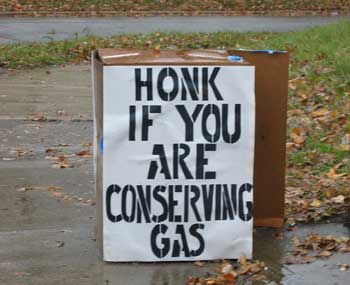
This afternoon, I spotted the following sitting in a driving rain on a street corner half a block away from our house.

A home-made sign reading, in big blocky stencil lettering, 'Honk if you are conserving gas'.

Uh…


Multi-Unit Any-Order Columns

Published 20 years, 6 months past

During last week’s workshop in Chicago, I was asked to discuss Alex Robinson’s One True Layout.  This presented a bit of a challenge, since the article and its contents are rather new.  While I’ve read through it all and grasped the main points, I wasn’t entirely sure I grasped the nuances.  For that matter, I’m still not entirely certain that I do.  And I tend to be wary of speaking about things I don’t fully understand.  Still, the audience was interested, so I took the plunge, figuring that I could stick to the bits I knew relatively well.

The Any Order Columns seem straightforward enough, once you get that it’s using margins to shift elements around.  The Equal Height Columns aren’t really, perhaps more properly being called “Extremely Tall But Clipped Columns”, but they simulate the job well enough to count.  And then there is the case of Vertical Grids, which I’m still pondering.

But as an illustration of why I say I’m not sure I grasp all the nuances, it was literally while presenting on this topic during the workshop that I hit on an extension of Any Order Columns (AOC) that allows for AOC to be used with columns of mixed width measures.  It came in response to a question about that very thing.  I’d been showing how to do AOC with columns sized with consistent units, like all with percentage widths or all with pixel widths.  But, an attendee asked, what if you wanted to have one column with an em width and another with percentages?

Say, for example, you wanted the first and second blocks (to use the terminology from Alex’s examples) to be the center and right columns, respectively, and the third block as the leftmost column.  Furthermore, suppose you want the left column to be 10em wide, the center column 40em wide with 1em ‘gutters’, and the right column to be 200 pixels wide.  I’m using pixels because it’s a commonly-used unit, but if it makes you feel better, assume there are Flickr images there or something similar in that column.

All right.  So we have to move the third block leftwards by 40em of center width, 2em of gutters, 10em of the space it will occupy, and 200 pixels of the rightmost column—the second block.  That’s 52em + 200px, which is exactly the sort of thing CSS doesn’t allow for a variety of reasons, some more reasonable than others.  IE/Win allows expressions, but only with a proprietary value syntax that nobody else supports.  And it potentially could be done with JavaScript, which would require pulling some font-size information in order to compute various em widths.

Or… we could relatively position a float, using the float’s margin to handle one of the measures, and the relative positioning to handle the other.  So you start like this:

#block3 {float: left; margin-left: -200px;}

That will get the third block to sit right on top of the second.  That’s taken care of the 200 pixels, but what about getting it the rest of the way?  Add the following:

#block3 {float: left; margin-left: -200px;
  position: relative; left: -52em;}

This puts the third block right where we want it.

There’s one exception: IE5/Mac, which doesn’t pay attention to the relative positioning when the element’s been floated.  So far as I’ve been able to discern, this is the one reduction of browser support from Alex’s original AOC.

With a little bit of math, you can make this work so long as the elements to the left of the shifted column use no more than three different units in their sizing.  To handle two types of units, you could do something like this:

#block1, #block2, #block3 {float: left;}
#block1 {width: 35em; padding: 0 20px; margin-left: 9em;}
#block2 {width: 12em; padding: 0 15px 1em 5px;}
#block3 {width: 8em; padding: 0 0.5em;
   margin-left: -60px; position: relative; left: -56em;}

(code example with browser workarounds)

This approach would permit the ability to drop in pixel-sized decorations, like separators or drop shadows or whatever, while preserving em-width column contents in order to scale with font sizes.

Now suppose you have a mixture of all three unit types, which is a case I didn’t tackle in the workshop.  I might even have said it wasn’t possible to handle, but if I did say that, I was wrong.  With the addition of a negative right margin on the second column, we can handle all three units, as seen here:

#block1, #block2, #block3 {float: left;}
#block1 {width: 50%; margin-left: 11em; margin-right: 1em;}
#block2 {width: 200px; margin-right: -200px;}
#block3 {width: 10em; margin-left: -50%;
  position: relative; left: -12em;}

(code example with browser workarounds)

Note that I’m not saying that you’d necessarily want to mix fixed-width columns with fluid-width columns.  Doing so is a potentially volatile mix when using CSS-driven design, and this technique doesn’t make it any more or less volatile.  If you want to do it, though, this is a powerful approach.

In the examples to which I pointed, I came across some intermittent appearances of the double-margin float bug in IE5.5/Win, though oddly not in IE6/Win.  I didn’t try to work around these inconsistencies beyond using the display: inline hack from Alex’s original examples, but I’m sure they’re surmountable.  It’s probably as good a case as any for using conditional comments to serve up fixes to pre-IE6 versions of IE/Win.

You may have noticed that, if the browser window is reduced in width, the columns start dropping in the two-unit example.  That’s something that could likely be handled with a sufficiently wide container, although doing that risks the dread horizontal scrollbar.  You’d get the same scrollbar with either older CSS layout approaches or with table-driven design, though.

I suspect there are even more combinations and nuances to be found in the AOC technique, and still more in the column and grid ideas Alex has laid out.  Hopefully I’ve made a good start here.  For any omissions or inaccuracies there may have been in my Chicago presentation, I hope the attendees and organizers will accept my apologies.


Browse the Archive

Earlier Entries

Later Entries